Siôn's 72-hour Neapolitan Pizza dough recipe
One of the first versions of my Neapolitan Pizza dough recipe, taken from many expert sources on the Internet and real books (!). This makes a large batch which should make around 15 or so pizza balls which can, of course, be frozen.
Equipment
- Dough tub with lid or large mixing bowl
- Deli pots (16oz) wth lids
- Scales, including a "jeweler"s scale that gets to 0.01g accuracy !
- Thermometer (optional)
- Bench scraper
- Couple of other bowls for mixing
Ingredients
Initial yeast mix
- 1300 ml filtered water room temperature
- 60 g salt
- 200 g Italian OO pizza flour
- 60 ml filtered water room temperature
- 0.25 g Instant dried yeast (not kidding !)
Main dough
- 1.8 kg Italian OO pizza flour
To line the individual pots
- Olive oil spray version
Instructions
Day 1. Making the dough.
- Take the larger amount of filtered water and put in the empty dough tub.
- Add in the salt and stir until dissolved.
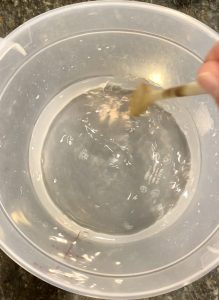
- Take the initial small amount of pizza flour and combine with the water/salt. Stir until all the lumps are gone.
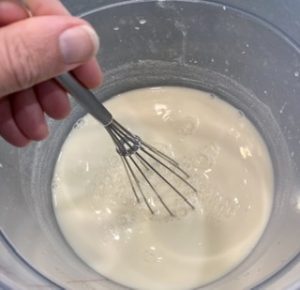
- In a separate small bowl, dissolve the instant yeast in the small amount of water. Let it hydrate for a minute and then mix gently until it's a uniform liquid.
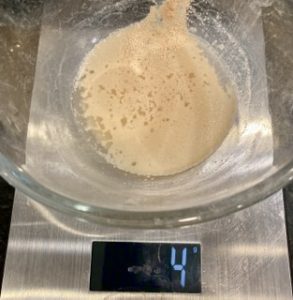
- Combine the yeast/water mixture into the water/salt/flour mix in the dough tub. Stir well. Doing it this way may sound like a hassle, but it prevents the yeast from being too shocked by the salt mixture.
- Gradually add in the larger amount of pizza flour until a dough starts to form. Be patient with this : a little at a time, making sure the dry flour is combined into the dough. It won't feel dough-like until you're about 75% through combining the flour.
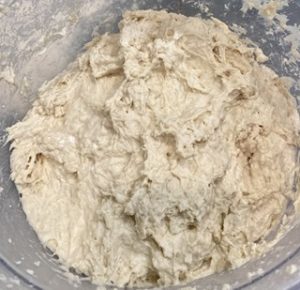
- At about ¾ of the way through, get your hand in there and start to combine using one hand. Hygiene first - you should have washed your hands at the start of this process of course. Wash them again before putting them in the dough.
- Use your hand to pull the wet and dry parts of the dough together, scraping the edges of the bowl as you go. The motion is basically a scoop from the bottom/edges and combining into the middle, ultimately to get this as uniform as possible. If you really must then use a wooden spoon or stiff spatula.
- Lightly flour a clean surface of at least 2ft x 2ft in size. Empty out the contents of the dough tub. Get your spatula in there and scrape every last piece of dough off the sides and bottom of the tub. Get any remaining wet or dry parts - you'll be kneading it all into a uniform dough. Do as much as you can to get the dough off your hand too and combine that in.
- You will need to sprinkle extra flour onto the dough mass at this stage, but don't go mad as it'll change the very important hydration (water to flour) ratio for the dough. A little flour here though is both necessary and OK.
- This time your hands wont get so messy. Knead the dough. Your goal is to get it all to the same consistency, kneading just for a couple of minutes or so. I like to use a motion that lightly punches a dent into the middle of the dough then fold the two sides of the dent over each other, bring in the sides and then repeat. Do what you need to do here. Keep sprinkling a little flour if you feel your hands are going to get messy.
- After two or three minutes, pick up the dough and place back into what should be a fairly clean dough tub (you DID scrape all the dough out of there, right ?).
- Before sealing it up, put the thermometer in the centre of the dough. It should read between 23°C and 26°C. That's 73-79°F.
- Cover the dough tub, or put the lid on it. This is about hydration, so you need a good seal here with cling-film (or whatever that's called in the USA). I invested in a dough tub with a lid - that's perfect.
- This needs to sit somewhere at room temperature for 24 hours. I like to keep mine on my desk in my study where its a little warmer and so I can keep an eye on it :-).
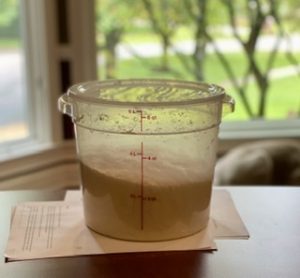
Day 2 (24 hours later !). Forming the dough balls.
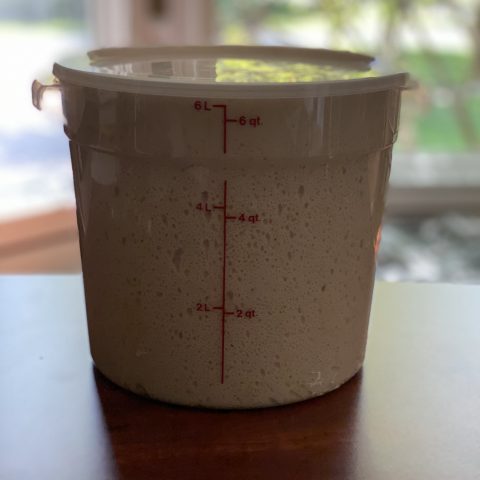
- The following morning the dough will have worked all on its own. It’ll be full of air bubbles and have doubled in size.
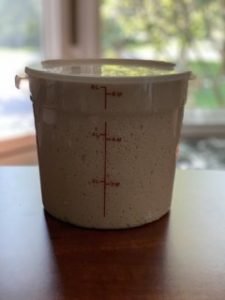
- Lightly flour the surface and pour out the risen dough from the tub onto the surface.
- Sprinkle a little flour on top if needed and shape the dough into a large "lump". Don't knead it at this stage.
- Take fifteen 16oz deli pots and spray some olive oil into them. Try to get the oil spray spread on the sides.
- Take the bench scraper or a knife and cut off 225g of dough from the dough mass. Add or subtract as necessary, and use the weigh scale. Get as close as you can to 225g in as few pieces as you can (ideally you’ll perfect this so you’re cutting off a 225g piece in one shot !)
- Make a dough ball. This is harder to describe than to show, but it's quite easy to do. It's essentially like a soft knead. Fold one edge over the other. Fold the sides in. Repeat a couple of times until it starts to resemble a ball. Pick it up so that all those seams are pointing upwards - turn it over so that the seams are at the bottom, and pinch/twist and shape into a ball with the "messy bit" at the bottom. The top should be nice and smooth. You may see a bubble or two already starting to form.
- Drop the ball into an oiled deli pot. Put a lid on it.
- Repeat this until you're out of dough and you've filled the pots - one ball per pot ! You should have around fifteen or so. Stack them up.
- Clean up and then do what is probably the hardest part - find some room in the refregerator for the fifteen pots. Put them in and leave them for 48 hours. Don't be tempted to freeze them immediately - the dough needs to second ferment and/or mature or something (or both). Let it do that in the fridge, then freeze after two days.
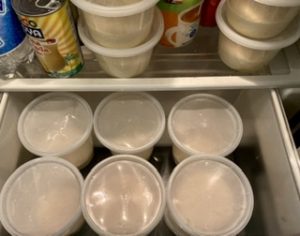
Day 4 (48-hours later...total of 72 hours). Consume or freeze - or both !
- We now have 72-hour dough in convenient tubs ! Congratulations. These can be used now or (as is most likely)...frozen. Put them in the freezer until needed.
- If using straightaway or in the next 48 hours after that, then just allow to come to room temperature for an hour before turning out and shaping into pizzas.
Much later...
- When removing from the freezer, allow to thaw slowly at room temperature for 2 hours before turning out and shaping into pizzas.